
Access mats / Uses
Power line rights-of-way
Solid footing for line crews, bucket trucks and cranes on soft, wet and remote rights-of-way across Alberta.
Get a quote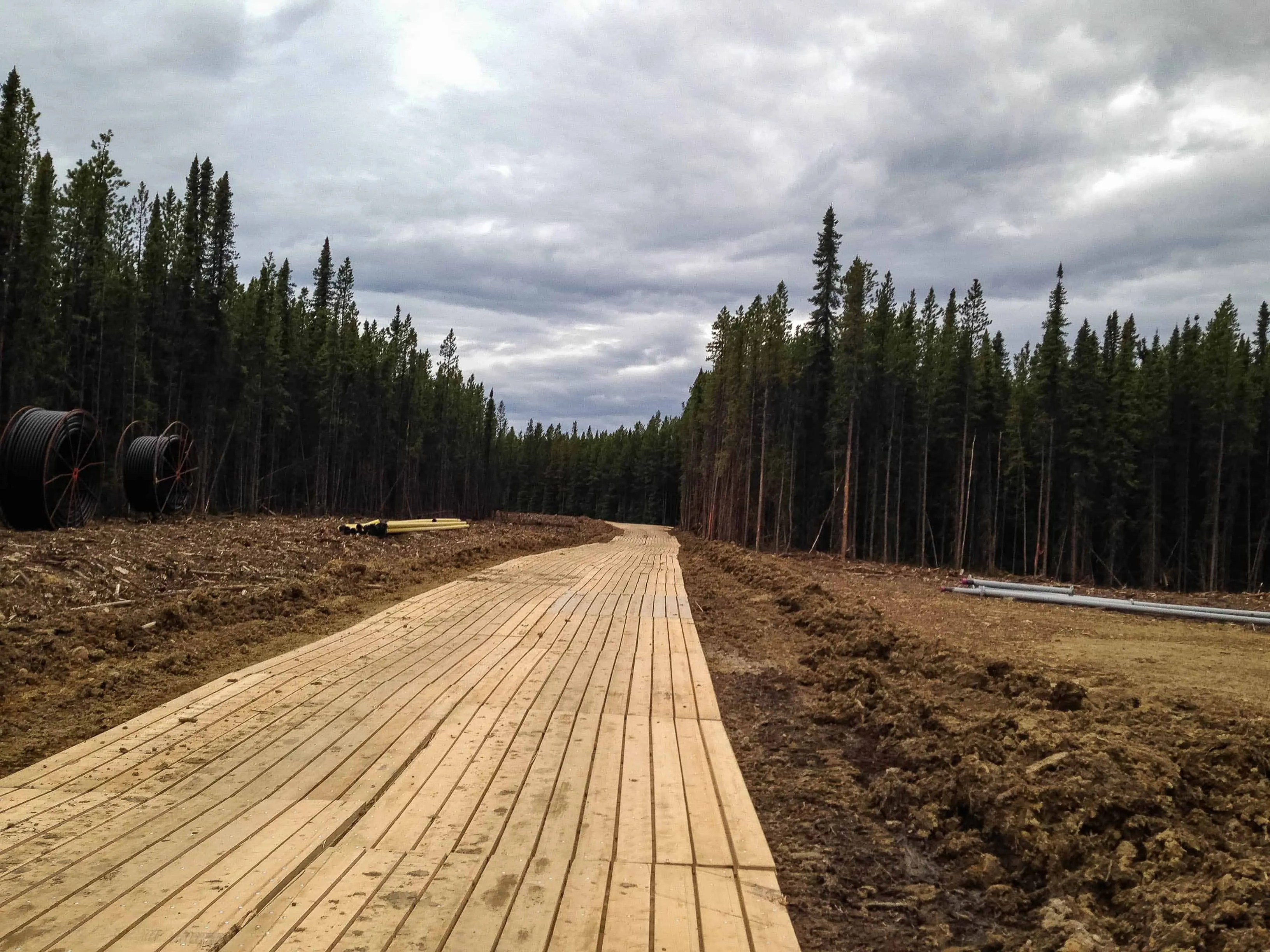
Mats for power line rights-of-way
Transmission and distribution lines rarely follow the high ground. Rights-of-way cut through muskeg, farmland, bush and low-lying wet areas, and crews still need to get heavy equipment to every structure. Our mats build travel lanes along the right-of-way and stable work pads at each pole or tower, so crews can work safely and the land is left in better shape when the job is done.
The challenge
- Remote, soft groundRights-of-way run far from developed roads, over muskeg, peat and saturated clay that won’t carry a loaded truck.
- Heavy, concentrated loadsCranes, diggers and bucket trucks set up on outriggers and put enormous point loads on the ground.
- Spring thaw and wet seasonsGround that was frozen and firm in February can turn to mud within weeks, and schedules don’t wait.
How our mats help
- 01Level crane and work padsInterlocked mats spread outrigger loads over a wide area and give crews a flat, stable surface at every structure.
- 02Travel lanes that hold upOur solid core and 181-bolt pattern stand up to repeated passes from loaded equipment.
- 03Less rutting and cleanupKeeping tires and tracks off the soil means less rutting and compaction to repair at the end of the job.
Mat details
- Core
- Solid core
- Boards
- 3-ply green Douglas fir
- Bolts
- 181 carriage bolt pattern
- Size
- 8′ × 14′
- Weight
- 1,880 lb
- Countersink
- Minimal
Common questions
Can mats be used for crane pads at transmission structures?
Yes. Mats are commonly laid in multiple layers or patterns to build crane and work pads. Tell us about your equipment and ground conditions and we’ll help you work out how many mats you need.
Do you deliver to remote rights-of-way?
Give us a call with your location and timeline. Our yard is set up for fast loading, and we offer 24 hour service.